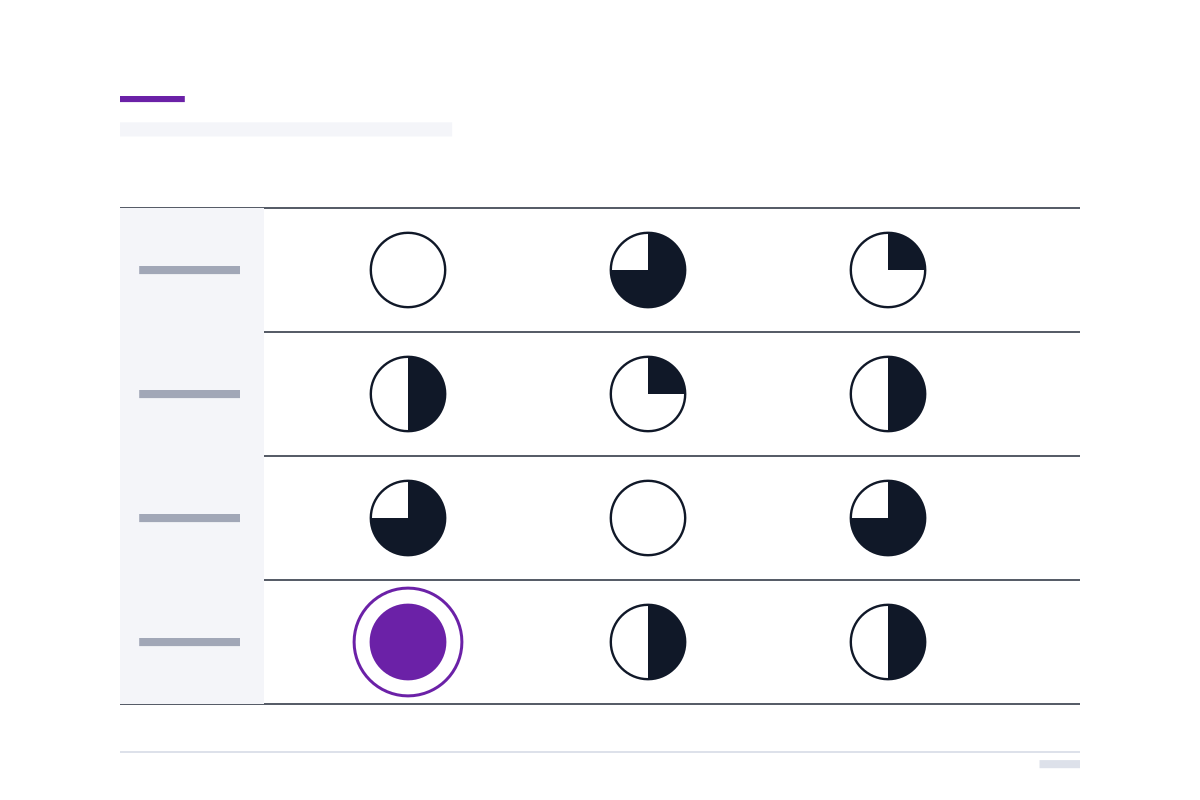


 RL
RL AV
AV RE
RE
4 on the panel
Send Weekly Ship or Kill Email
Joe SpisakCEO, Fulfill.comI fired an executive sponsor once. Not literally, but I told our board member to stop attending our weekly ops meetings because his questions were paralyzing the team. Best decision I made that quarter.
The problem with executive sponsors is they get paid to see risk. You get paid to ship product. When I scaled my fulfillment company from zero to ten million, I had an investor who wanted to approve every warehouse layout change over five thousand dollars. We were adding 40,000 square feet and every decision became a three-email thread about ROI models. I was spending more time building decks than building the business.
Here's the brief that worked: I started sending a weekly "ship or kill" email every Friday at 4pm. Three sections. What we shipped this week with actual numbers. What's blocked and the dollar cost of delay. What I'm killing because it's not worth the cycles. That's it.
The cost of delay part changed everything. Instead of "we need to decide on the new WMS," I wrote "delayed WMS decision is costing us 18 labor hours per week in manual workarounds, that's $47,000 in Q4 if we wait until November." Suddenly my sponsor wasn't asking for more analysis. He was asking what he needed to read to make the call by Monday.
The kill section built trust. Showing him what I was actively choosing NOT to do proved I wasn't just empire building. When he saw me axe a project he'd originally championed because the data changed, he stopped second-guessing the projects I was pushing.
Most founders think executive sponsors need more information. Wrong. They need confidence you're managing risk without them. That weekly email took me twelve minutes to write and saved me six hours of meetings. At Fulfill.com, I still use this format with our board. Decision velocity is a competitive advantage. Your sponsor should be a rocket booster, not a brake pad.
Present One-Door Choice Memo
Runbo LiCEO, Magic Hour AII'm Runbo Li, Co-founder & CEO at Magic Hour.
The executive sponsor isn't disengaged. They're under-informed. And the fix isn't more meetings, it's a sharper frame for the one decision that actually matters right now.
I call it the "one-door brief." Every time progress stalls, it's because someone downstream is waiting for a call that feels too big or too ambiguous to make on their own. So instead of sending a status update or scheduling a sync, I send one page with three things: the single decision needed, the two best options with a clear recommendation, and what happens if we don't decide by Friday. That's it. No background deck, no appendix, no "context setting." Just the door we need to walk through.
This came from real pain. Early on with Magic Hour, David and I were working with a partner org on a distribution deal. Their internal champion loved us, but every week some new "alignment conversation" would push the timeline. I realized the champion wasn't the bottleneck. Their VP was. And the VP wasn't ignoring us, they just never had a clean ask in front of them. So I wrote a one-paragraph email: here's the deal, here's what we recommend, here's the cost of waiting another two weeks. The VP replied in four hours and we closed it.
The pattern I see constantly is that people try to keep executives engaged through volume. Weekly updates, dashboards, Slack channels. That's noise. Executives stay engaged when they feel like their involvement is high-leverage, meaning you only come to them when their specific authority unlocks something nobody else can. The moment you start looping them in "just to keep them in the loop," you've trained them to tune out.
So the one brief that consistently works: make the decision feel small and urgent, not big and strategic. Frame it as "we need a yes or no on X by Thursday so the team can ship Y." Executives love clarity. They hate ambiguity disguised as collaboration.
Don't keep your sponsor engaged. Keep them decisive.
Use Mission-to-Metric Card
Adam Vibe GuntonFounder and Managing Partner, Behavioral Health PartnersI'm the founder of Recovered On Purpose and I run Behavioral Health Partners, so my "exec sponsor" is usually a CEO/owner or medical leader at an addiction treatment program while we're trying to ship licensing, operations, and admissions growth fast. When day-to-day slows progress, I keep them engaged by moving them out of the weeds and into one weekly "decision window" with only 1-2 irreversible choices; everything else becomes a team-level call tied to policies/procedures and accreditation criteria.
The brief that unlocks blocked decisions for me is a one-page "Mission-to-Metric Decision Card." It has: the decision in one sentence, the deadline (what breaks if we wait), two options only, the risk/compliance impact (patient safety, licensing, ethics), the admissions impact (how it changes calls/inquiries), and the owner for execution. The sponsor only answers three prompts: "Is this ethical?", "Is this compliant?", "Does this increase access to care?"
Example: when a center is stuck debating website copy vs admissions flow vs "more content," I put the decision as "Approve the admissions path + insurance/payment clarity above the fold this week." If they approve, my team executes and we measure calls/leads; if they don't, they must pick what they're willing to sacrifice (speed to access, clarity for families, or staff time).
If they still stall, I reframe it as a "patient waiting room" problem: every day we delay, real people who don't understand detox/residential/long-term options keep scrolling and giving up. Execs don't ignore decisions when it's framed as access to care plus compliance risk, instead of internal preferences.
Educate Sponsors with Assessment and Consequences
Randall EnglundExecutive Consultant, Englund Project Management ConsultancyTalking with project managers world-wide, we find the level of support from executive sponsors is generally dismal. Sponsors do not always understand their role, are too busy to respond in timely manner to requests for resources or decisions, and often disappear after projects begin. Many sponsors do not realize they are the problem for why projects suffer, are delayed, or go over budget. The approach that co-author Alfonso Bucero and I take is to educate sponsors on their critical role in project success, encourage regular two way interactions, and work with them to create excellence in project sponsorship. We offer executive briefings whenever possible. One way to get their attention is to ask them to complete a short sponsor assessment tool. A project manager, colleague, or team member may bring this assessment to them or give them a copy of our book, "Project Sponsorship: Achieving Management Commitment for Project Success," and request a dialogue about the contents. This approach allows sponsors to self discover how poorly they are perceived in supporting projects. Another approach is to share consequences of blocked decisions. It's important to speak the language that sponsors understand, such as success/failure, market share, return on investment, impact of delays, and performance issues. They are less interested in project details. We encourage project managers to tap courage, manage up the organization, and speak truth to power. It's helpful to get other respected executives involved to share their approach so problematic sponsors see how they can perform better.
More details available at https://englundpmc.com/project-sponsorship.