
The Source for Consulting ProfessionalsUpdated October 26, 2026
Strategy shifts mid-project can derail timelines and budgets, leaving consultants scrambling to realign resources without losing momentum. This article brings together proven methods from seasoned consultants who have successfully reset scope and spending when priorities change. Readers will learn practical steps to preserve value, cut waste, and keep projects on track even when the original plan no longer fits.
 WM
WM JH
JH OM
OM RR
RR AG
AG TW
TW ES
ES
19 on the panel
Maurice HararyCEO & Co-Founder, Bid BananaWhen strategy changes mid-engagement I decide what to pause, re-scope, or cancel by tying every requested change back to the project's core requirements and keeping the Scope of Work draft on hand as an objective anchor. If a change aligns with those requirements and does not compromise timeline or quality, we re-scope it into the current work; if it is out of scope but valuable, we suggest saving it for the next project or formalizing it as an additional engagement. If a change would derail deliverables or create unacceptable risk to the current commitment, we pause work and discuss options rather than proceed from momentum alone. In the first conversation about change I validate the idea, then anchor the discussion with, "I love that idea, but the project scope clearly states the requirement is X," and then truthfully outline timing and resource implications to set up a fair renegotiation.
Will MitchellFounder, StartupBrosI list every deliverable currently in motion and tag each one with a simple filter: whether it still moves the needle for where we're headed now. Anything built for the old direction gets paused immediately. I pause because sometimes pieces can be repurposed, but I stop spending time and money on them until we know.
The first conversation about change always starts with me putting a dollar figure on what's already been spent and what's still owed. I put the real cost on paper so both sides are looking at the same accounting before we discuss scope.
From there, I separate what's already delivered and usable from what's half-finished. The half-finished work is where sunk-cost thinking hides. If completing it costs more than starting fresh under the new strategy, I walk away from it and price the remaining work against the new goal.
Justin HerringFounder and CEO, YEAH! LocalHere's how I handle SEO work: I set clear time limits from the start, like 90 days for a content test. If our goals change, we can stop at a natural point rather than abandoning something mid-stream. I always ask clients if the timeline still makes sense or if we should cut it shorter. This approach saves time and gives us obvious moments to pause and check what's actually working.
Oscar MoncadaCo-founder and CEO, Kalos by Stratus10The first thing we do when a strategy shift surfaces mid-engagement is to understand why the client wants to change direction.
A shift driven by a genuine change in business requirements is different from one driven by a team chasing a newer technology. We provide context, education, and, if needed, pushback before re-scoping begins.
Once a reason is established, we assess the shift against three variables: effort, cost, and timeline impact. Smaller shifts that don't disrupt in-progress work get handled without major renegotiation. Shifts that would derail completed work go back to the client with a full impact summary before any conversation about scope or budget changes.
A fair renegotiation starts with presenting that impact summary before any number is discussed. When the client sees specifically what stays, what pauses, and what gets rebuilt, the conversation starts from a shared context rather than competing positions. In most cases, clients choose to protect the work already done.
Rebecca RushtonFounder, Blister PreventionWhen you are deep into developing a new commercial product or rolling out a pharmacy distribution channel, a sudden shift in strategy can feel like a massive blow, especially when you've already sunk thousands into it. Early on, I used to push through failing projects out of sheer stubbornness, which only wasted more resources. Now, my rule for avoiding the sunk-cost trap is to immediately separate the project's past expenses from its future utility—if the remaining work doesn't solve a current, live friction point for our business or customers, it gets cancelled or re-scoped without sentimentality. In that very first conversation about a mid-stream change, the single step I always take is to establish a clear "re-baselining of resources." I ask everyone to look strictly at what assets, data, or product components we can salvage for the new path forward, rather than tallying up what we lost. My advice is to approach renegotiations with a focus on clinical utility: treat the initial contract as a fixed-term diagnostic phase, and frame the pivot as an informed prescription for a better outcome, which naturally sets up a fair, collaborative adjustment of fees and timelines.
Andrew GazdeckiCEO, Acquire.comIf mid-planning the approach shifts - well, bye-bye to tasks that no longer are relevant, then. One of our buyers simply told us that our pricing was out-of-date and we immediately paused marketing. We re-calculated based on market realities and prioritized what made sense - shaving several weeks of time.
That real world, market-generated intelligence - that's what I bring into that first conversation, so we can adapt rapidly and establish alignment on what happens next.
Travis WilsonChief Operating Officer, The Lakes Treatment CenterWhen our strategy changes mid-project, my first move is simple. I look at what's actually helping patients get better and pause everything else that isn't tied directly to their safety. In the first meeting, I ask the team to help rank these programs by impact. We decide together what stays and what goes. It's a straightforward way to make sure everyone's voice is in the room and we don't keep things going just out of habit.
Emma SansomManaging Director, Flamingo Marketing StrategiesA client just changed their overall priorities from brand building to lead generation. I sat them down on a call right before we implemented any changes, put a halt to their underperforming lead gen content, and together we worked out and planned the entire lead generation strategy with them right there and then. We essentially put their entire score card together and broke their whole approach down and restructured the whole plan around quick wins for each and every action taken.
 Lance TestaGroup Commercial Director, Van Compare
When our plans have to change midstream, I grab a whiteboard and list everything we're working on. Then we sort it with two simple questions: is this legally required, and does it actually make us money? I call it the "must-do vs. nice-to-have" list. Once everyone sees that simple breakdown, the arguments about what to drop just stop. It helps us focus on what matters now, not what we've already spent time on.
 Meriem AousajiMarketing Director, Algomizer
Working on AI means things change fast. I sort projects into three buckets: experiments, support work, or stuff that directly impacts the brand. The experiments are the first to go when we need to shift focus. Last quarter, we froze a non-essential AI feature and put that time into a big branding push instead. When priorities change, I just tell the team straight up what our budget and timeline for R&D really are. It keeps everyone on the same page and stops confusion later.
 Liviu MultiplyFractional CMO, Multiply CMO
The sunk cost trap in mid-engagement strategy shifts is almost always an emotional problem disguised as a financial one. Both sides feel the weight of what has already been invested, which makes the conversation about what to do next harder than it needs to be. The past investment is real. It is also irrelevant to the decision about what to do next.
The one step that sets up fair renegotiation in the first conversation about change: agree explicitly that the decision about what to do next will be made entirely on the basis of what is most likely to produce the right outcome from this point forward, with no weight given to what has already been spent.
Stating that principle out loud at the start of the conversation does something important - it gives both parties permission to recommend the option that is actually best, including pausing or cancelling, without either side feeling they are invalidating the work already done. The work already done happened. It produced learning. That learning informs the next decision. The investment behind it does not.
At Bacon, the conversations that went badly were the ones where we tried to justify continuing a strategy because of what had already been spent rather than because it was still the right path. The conversations that went well started with this question: if we were starting fresh today with everything we now know, what would we do? That question cuts the sunk cost framing entirely and produces a recommendation both sides can trust.
The renegotiation becomes fair when the criteria for the decision are agreed before the options are discussed.
 Kyle BoltonFounder, CrewHR
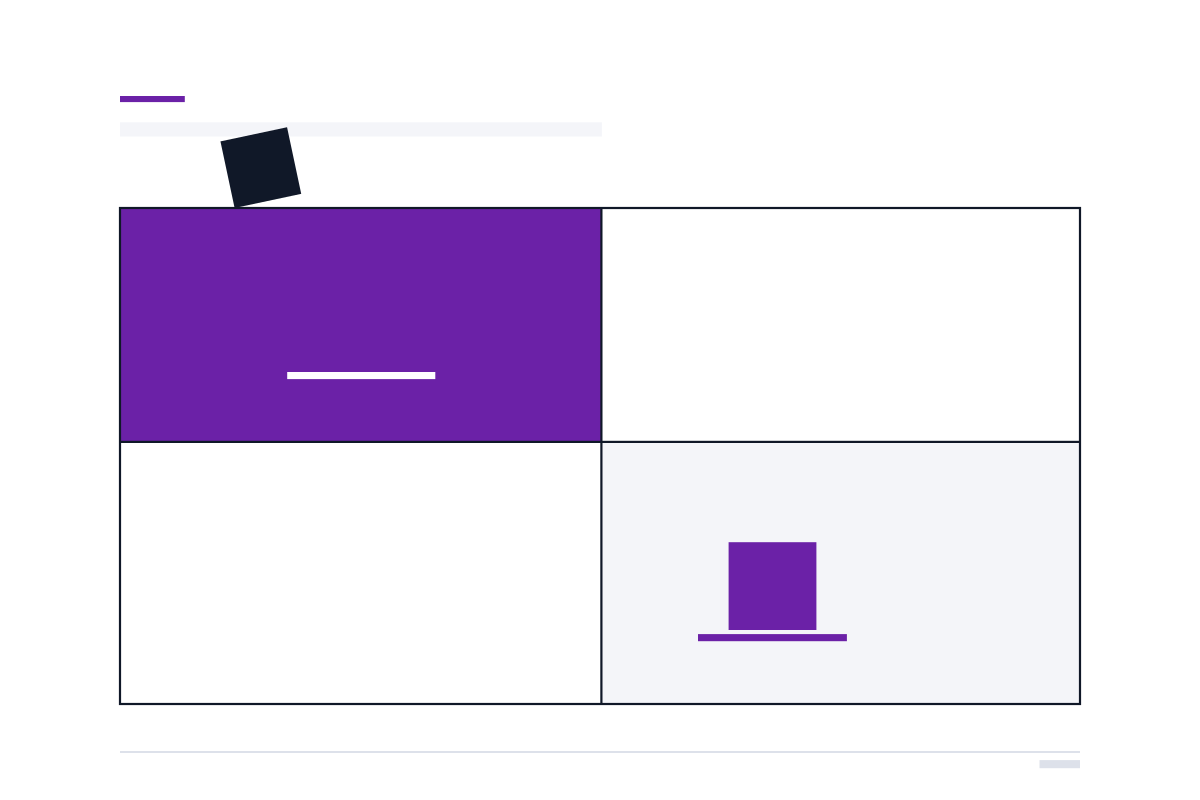
When a project has to shift mid-stream, I'll step back and draw a simple grid. One side is cost, the other is how much it actually helps. This lets us pause the expensive stuff that isn't crucial. On the CrewHR project, we had the client build the grid with us, so they were part of every cut. It stopped any surprises later on. My advice is to frame that first talk as you solving the problem together, not you dropping the bad news on them.
 Sergen YilmaFounder, Gents
When I need to decide what to cut, I just ask if it fits our two principles: ambition and self-respect. It's how I stop myself from throwing good money after bad, even on ideas I love. So when something has to change, I start there. It reminds everyone what we won't compromise on, and it makes the hard conversations a lot more straightforward.
 Kartik ChughCofounder, FORKOFF
When a strategy shifts mid-engagement I use cost-per-qualified-view as the single decision metric to decide what to pause, re-scope, or cancel. We compare the campaign's current CPV to the agreed target and pause work that pushes CPV above the acceptable range, re-scope pieces that can be made more efficient, and cancel low-probability bets rather than extending sunk costs. Across our cohort of about 42 founder-led operators the CPV break-even for AI tools versus managed services sits at roughly 50 clips per week: under 50 clips AI tools tend to win at under $0.10 CPV, and over 50 clips the managed service drops to roughly $0.003 CPV. That simple breakpoint helps teams stop defending past spend because continued work is tied to a clear economic outcome instead of history. In the first conversation about change I run and share a quick CPV calculation, something we can do in roughly 25 minutes, so everyone sees the trade-offs in dollars and output. With that shared math on the table we can fairly renegotiate scope, pause specific channels, or convert parts of the engagement into time-limited experiments with explicit CPV targets.
 Kevin LourdFounder, Distribute.you
I run an AI outbound platform called Distribute, but our custom technical implementations function a lot like ongoing consulting engagements. When a project strategy shifts mid-delivery, we generally decide what to scrap by looking at whether the current path will cause active external damage. We ignore the hours we've already sunk into the original plan.
For example, we were recently building an automated outbound pipeline for a user. Mid-delivery, we realized the AI was leaving raw corporate markers like "Inc." attached to prospect names. Pushing that unpolished output would have triggered instant hard bounces and tanked their sender domain reputation. They asked us to completely restructure the flow to add a mandatory manual holding queue. We had to stop the line and rip out the fully automated feature we just finished building.
It was a massive scope increase. To set up a fair renegotiation for the extra work, the first thing I did in that conversation was deliberately absorb an immediate cost to protect them, using that moment to reset our pricing boundary. I told them, "We are absorbing the engineering hours to build this manual holding queue today because launching as-is will actively damage your sender domain. Going forward, adding any additional custom nodes will require a separate, updated rate."
It cost us some unbilled engineering time upfront, but giving them that structural safety net for free completely removed the friction from raising our rates for the rest of the new scope.
 Alykhan KaraCEO, Appear
When our plan changes at Appear, I immediately look for what we can cut. We'll keep the stuff that's critical for AI search visibility, but we might drop some automation reports or other details. Having an "experiment lane" with its own budget helps the team stay focused and not get bogged down by past work. When I first sit down with a client to renegotiate, I draw out a few different paths forward so they're part of the call on what we pause.
Sunk-cost traps become common when teams mistake continuity for stability. A strategy shift often means the original sequence of work no longer makes sense, even if individual tasks still look competent in isolation. I start by reviewing where the engagement has created strategic assets versus where it has only created motion. That difference matters. Assets can often be preserved or repurposed. Motion usually cannot. In white-label and partnership-heavy environments, keeping nonessential motion alive creates friction that shows up later as missed deadlines, diluted focus, and weaker retention.
The first step in a fair renegotiation is to ask what must remain non-negotiable. Once those guardrails are clear, everything else becomes adjustable, including pace, ownership, and reporting expectations. That prevents change discussions from becoming broad, emotional, and commercially unproductive.
 Iman BahraniDirector, Searchical
When an SEO strategy changes mid-stream, I look at what will actually make money in the next ninety days. That tells us exactly what to pause or change so we don't waste time. I like to sit down and compare the old projections with the new numbers. Being that open about the data helps us agree on a new scope quickly without the usual back and forth.
 Yash KakuCEO, VedaCreatives
When a client changes direction halfway through a project, I immediately pause anything we can't easily reverse, like printing or fabrication. We had to do this at VedaCreatives during a big rebrand. The team would identify the next point of no return and get the client to re-approve it. It just saves everyone from that awful moment when you have to throw out expensive work nobody wants anymore.
More from the same file.
When a project sponsor leaves or changes roles, even well-planned initiatives can quickly lose direction and momentum. This article draws on insights from experienced consultants who have successfully guided organizations through these critical transitions. Learn practical strategies for resetting stakeholder alignment and keeping projects on track when leadership changes occur.
Q&A · Apr 22
Executive sponsor turnover can derail even the most well-planned client projects, creating confusion around priorities and threatening timelines. This article presents five proven strategies for managing leadership transitions smoothly, drawing on insights from project management experts who have successfully navigated these challenging situations. Learn practical techniques to maintain momentum and preserve stakeholder alignment when key decision-makers change mid-project.
Q&A · Apr 15
Client data delays can derail timelines, but experienced consultants have developed practical strategies to maintain momentum. This article compiles insights from industry experts who share six proven techniques for keeping projects on track when access is restricted. These methods allow teams to build structure, validate assumptions, and prepare deliverables before real data becomes available.
Q&A · Jun 1