
Most operational efficiency engagements I have seen as an outside specialist do too much, too soon. The consultant arrives, runs a discovery, builds a 50-page deck, and presents it to a leadership team that nods politely. Three months later, two of the recommendations are in flight, four are stuck in committee, and the rest are quietly forgotten.
I run a niche consulting practice that focuses on website performance for mid-market and enterprise companies. The discipline of having to deliver measurable results in 30 days has reshaped how I think about strategy work in general. Strategy decks rarely fail because they are wrong. They fail because they ask too much of the people who have to act on them. The work that actually changes a business almost always starts with one carefully chosen lever.
Find the bottleneck that touches the most processes
Operational efficiency is most often a bottleneck problem, not an effort problem. Companies that look "inefficient" are usually working hard. They are just working hard against a single point of friction that is invisible because everyone has learned to live with it.
The first job of an operational audit is to find that point. The framework I use is simple. List the top 10 processes the company runs every week, from sales onboarding to monthly reporting. Then, for each process, identify the one step that adds the most cycle time relative to its complexity. The bottleneck is the step that shows up across the largest number of processes.
For one of our clients, a B2B services firm with 80 staff, the bottleneck turned out to be approval cycles in their CRM workflow. It was not glamorous. It touched seven of their 10 critical processes. Fixing the workflow in two weeks freed up an estimated 18 hours of management time per week, with no headcount change.
Pick a metric that the team already trusts
Consultants love new metrics. Operators trust the metrics they already use to run the business. If you introduce a new score, a custom efficiency index, or a fresh KPI to track your impact, you have already added friction.
Pick a metric the leadership team has been reporting on for at least 12 months. Then commit to moving that one metric. The fight over what to measure ends, and the conversation moves to whether the change is working.
In our work, that metric is almost always either revenue per visitor or page-level conversion rate. Both already sit in the dashboards the company uses. Both are credible to the executive team, the marketing team, and the engineering team without having to be explained.
Stop ranking recommendations by impact alone
Most strategy decks rank recommendations by potential impact. That is the wrong sorting algorithm for an organization in execution mode.
The better approach is to sort by ratio of impact to friction. A recommendation that produces a 5 percent revenue lift but requires three teams to coordinate over four months is rarely the right place to start. A recommendation that produces a 1.5 percent revenue lift but can be implemented by one team in two weeks almost always is. Once you have momentum and a small win, the harder work becomes much easier to fund and staff.
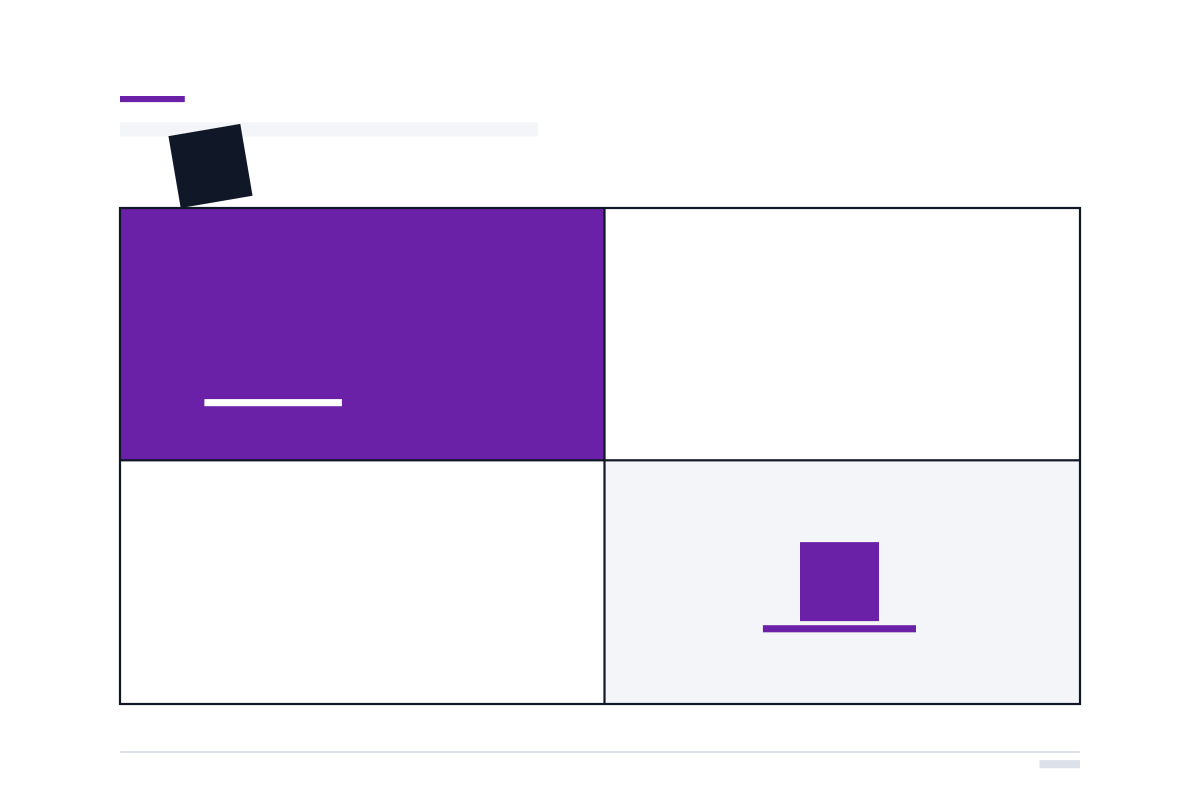
I rank every recommendation we make on two axes. Expected impact, scored conservatively. And implementation friction, which I score by counting the number of teams, sign-offs, and tooling changes required. Anything in the top quadrant of impact-to-friction ratio is what we tackle first.
Run a 30-day proof, not a 90-day plan
A 90-day strategy plan is a hostage situation. Anything can happen in 90 days. Three months in, the executive sponsor may have changed jobs, the budget may have shifted, and the original brief may not even be relevant anymore.
A 30-day proof avoids most of that risk. Pick the one operational change with the best ratio of impact to friction. Implement it in 30 days. Measure the agreed-upon metric for 30 more. Then, and only then, decide what the next 90 days look like, with real evidence in hand.
This pattern feels slower on paper. In practice it ends most engagements with more change implemented in six months than the alternative produces in 12.
What this looks like in practice
For a recent retail client, we ran the entire diagnostic in two weeks. The output was a single recommendation, not a deck. The recommendation, fix three specific page templates that handled 60 percent of their search traffic. Implementation took 18 working days. Their organic conversion rate on those pages improved by 23 percent in the first 60 days after launch.
The temptation in any consulting engagement is to do too much. To prove your value through volume. The harder discipline, and almost always the more useful one for the client, is to do less and to do it where it actually moves the business. The 50-page deck is comfortable. The single, well-chosen lever is the work that gets remembered.