

The brief
The Source for Consulting Professionals
Data Center Due Diligence Has a Physical Blind Spot
Why credible infrastructure claims can still produce an unworkable site
The shortlist looks convincing. The facility has available power, multiple carriers, resilient infrastructure and 24/7 access. Each answer is supported by a document. None of the answers is necessarily wrong.
Yet the project may still fail the test that matters: can the proposed capacity be delivered on time, through genuinely independent paths, and supported at 2 a.m. when the people making decisions are hundreds or thousands of kilometers away?
Desktop screening is efficient at the longlist stage. The problem begins when its shorthand survives unchanged into the final recommendation. Teams verify the nouns—power, carriers, redundancy and access—but not always the verbs: deliver, isolate, switch, reach and recover.
A carrier logo is not route independence. A megawatt figure is not an energization date. A design or facility certification does not, by itself, describe how a site will operate under pressure. A 24/7 access clause does not tell a vendor engineer how to get through the gate on a public holiday.
These are useful proxies for screening. They become dangerous when the investment decision depends on conditions the proxy was never designed to prove.
A True Claim Can Still Mislead the Decision
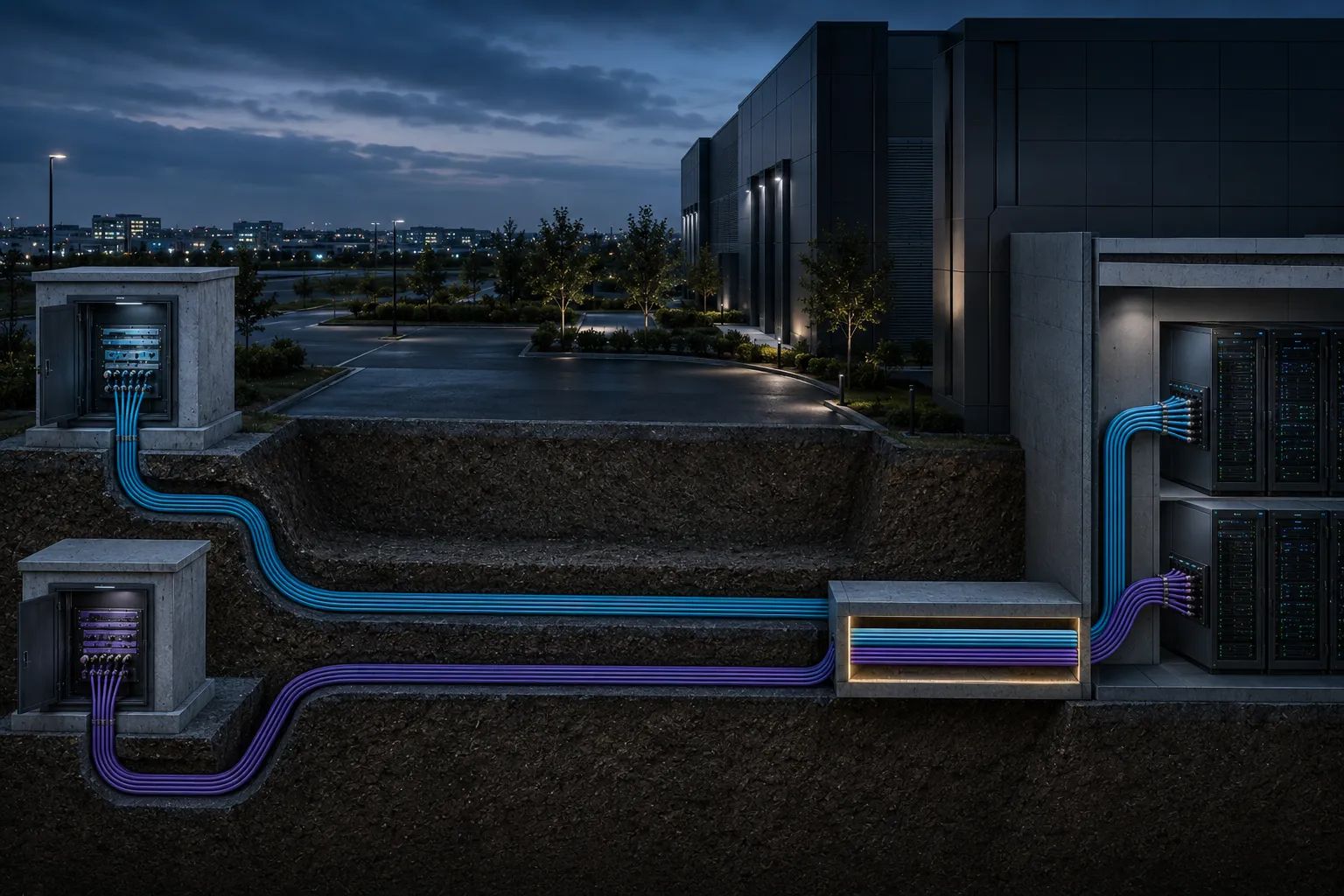
Consider “two carriers are available.” The statement may be accurate while both proposed services enter the property through the same duct. The review has not found a lie; it has accepted an answer at a lower resolution than the decision requires.
A four-line test exposes the gap. For every assumption that could change the site choice, design, schedule or commercial terms, write down:
- The claim: What, precisely, is being represented?
- The evidence: What can be inspected, traced, tested or independently corroborated?
- The conditions: What else must be true—or must happen, by when and by whom—before the claim becomes usable by this project?
- The consequence: What changes if the condition is not met?
For the carrier example, route diagrams, construction records and witnessed inspection may provide evidence; separate building entries and non-convergent metro paths are the required conditions. Until those conditions are shown, the design should treat both services as one failure domain—not as “information pending.”
Follow the Dependency, Not the Label
The most valuable validation usually begins where a reassuring label stops.
Power: from headline capacity to an energization path
The word “available” can describe several different states: capacity exists upstream; infrastructure is installed on site; capacity is unreserved and allocable to this project; or the required load can be energized at the agreed delivery point by the required date. Those states are not interchangeable.
A realistic review separates what is installed, what can be allocated now and what depends on future works. It also establishes what redundancy remains during planned maintenance and what happens if a fault occurs in that state. If a feeder, substation upgrade, transformer, switchgear delivery or utility approval sits on the critical path, it belongs in the investment case—not in a technical appendix.
Use each artifact for the question it can answer: a utility commitment and delivery program for timing; a load schedule and single-line diagram for topology; inspection for current physical state; and contract terms for unfinished obligations.
The decision test is: What load can this project receive, at what delivery point, by what date - and which unresolved dependency can still move that date?
Connectivity: from carrier count to failure domains
Counting providers is easy. Establishing independence is harder.
Separate suppliers and contracts do not guarantee separate building entrances, ducts, meet-me rooms, metro routes or upstream international paths. A design can have procurement diversity without meaningful physical diversity.
Follow each proposed service from the property boundary to the handoff and identify where paths converge. Route details may be sensitive, but a controlled review, redacted diagrams, witnessed inspection or evidence shared under an NDA can protect them without leaving the decision untested.
The decision test is: Which single physical event can interrupt both services?
Resilience: from installed topology to controlled action
Equipment topology shows what a facility was designed to withstand. It does not show how people will use that design under pressure.
This is why a design certification, a constructed-facility certification and an operations assessment answer different questions. Uptime Institute, for example, separates Operational Sustainability from its design and constructed-facility certification stages.
Operational resilience depends on authority, staffing, maintenance discipline and rehearsed recovery. Who can approve a high-risk intervention? Are current methods of procedure available? When was the last relevant drill? Can the on-site team give remote engineers reliable evidence—indicator states, cable paths, timestamps and test results—before the next action is authorized?
The decision test is: During the first hour of a plausible failure, which action must succeed, who can authorize it and can the current team demonstrate the sequence?
Access: from a service promise to hands on equipment
“24/7 access” compresses an entire chain of dependencies into three characters and a slash.
An urgent intervention may require prior identity registration, after-hours approval, an escort, a work permit, security clearance for tools or coordination among the facility, a carrier and a hardware vendor. Each step can be reasonable. Together, they can turn immediate access into a multi-hour delay.
Walk through a plausible incident before go-live. It is 2 a.m. on a public holiday. The primary engineer is abroad and a vendor specialist must attend. Who opens the request? Who may authorize entry? Which information must already be on file? Who can receive equipment? Who has stop-work authority? When does responsibility pass from one organization to another?
If the sequence has no clear owner in a calm meeting, it will not acquire one during an outage.
If the Visit Cannot Change the Decision, It Is a Tour
When a site visit is scheduled after the preferred option is already obvious, confirmation bias is built into the itinerary: presentation, guided tour, photographs, lunch.
A useful visit starts with a harder question: What could we observe today that would change the design, the commercial terms or the site selection?
That question turns the visit into a test of material assumptions. Trace the proposed network paths. Stand at the planned point of delivery. Walk the after-hours access sequence with the people who would actually execute it. Ask to see the evidence behind the claims carrying the most downside—not every room in the building.
The language changes as well. “Please confirm” invites another representation. “Please show us” invites evidence. “Let us walk through what happens next” exposes dependencies and ownership.
Precise validation need not be adversarial. Problems found before commitment are usually negotiable; the same problems discovered during mobilization or an outage are expensive facts.
A Finding Must Change Something
Decision-makers need the gap, not a photo archive. For each material assumption, report the claim, evidence, remaining condition, owner and consequence. An unknown with a large consequence is a finding, not an empty cell.
A useful finding ends in a decision: obtain proof before award, make delivery a contractual condition, redesign around the uncertainty, price and accept the residual risk, or reject the option. If a finding cannot influence any of those choices, it is probably background information rather than due diligence.
This also prevents contractual language from being mistaken for technical proof. A contract can allocate responsibility and provide a remedy. It cannot make services in a common duct physically diverse or energize capacity that depends on unfinished work. A successful demonstration provides evidence of capability under the conditions tested; it does not show that the capability will be maintained for the life of the agreement. Physical evidence, operating practice and commercial commitment are complementary; they are not interchangeable.
No market-entry decision is made with perfect information. The aim is not to eliminate uncertainty. It is to stop a convenient proxy from being mistaken for the condition on which the project depends.
A shortlist is built from nouns—power, carriers, redundancy and access. Due diligence earns its value by testing the verbs: deliver, isolate, switch, reach and recover—before the project has to rely on them.